
Project requirement
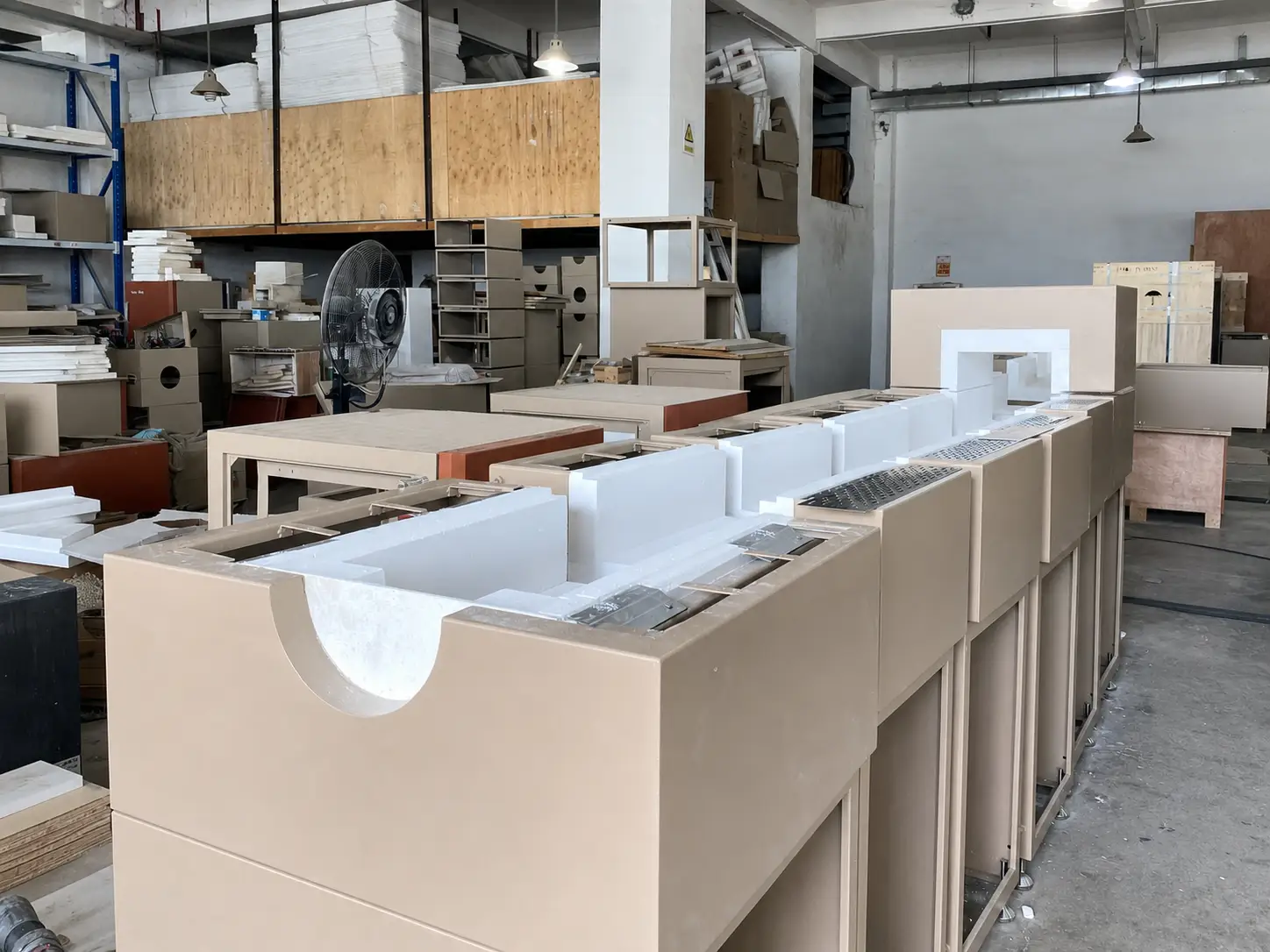
The equipment evidence records a long furnace assembly under construction. A continuous process opening passes through repeated insulated and metal-enclosed sections, creating a different engineering problem from a compact single-chamber furnace. Total length, section boundaries, support, heating, sensing and service access must be coordinated before the enclosure is closed.
Why total length was divided into physical sections
A long heated path cannot be treated as one enlarged box without reviewing manufacturing, transport, thermal expansion and maintenance. The photograph shows repeated enclosure sections aligned around one internal path. Each joint must maintain clearance and insulation continuity while allowing the complete assembly to be manufactured, moved, installed and serviced.
Keep the process opening continuous
The usable opening must be defined independently from insulation thickness and outside cabinet dimensions. A dimensioned axial drawing should identify the load, tube or conveyor path, the position of every section, entry and exit supports, joints, end equipment and maintenance clearances. Alignment decisions affect the hot-space interface even when the surrounding cabinets are built separately.
Define thermal sections from the process objective
Multiple physical sections do not automatically prove independently controlled zones or a uniform temperature profile. The required process positions, setpoint relationships, sensor locations and loaded verification method determine whether sections are controlled together or separately. Adjacent zones interact through insulation, load, process tube, gas flow and the section joints.
Coordinate support and thermal movement
The frame and adjustable feet shown in the assembly support a long enclosure, but the final foundation, level, anchor and expansion strategy depend on installed length and operating duty. The project drawing should distinguish fixed references from locations that allow assembly tolerance or thermal movement.
Plan access before closing the enclosure
Element terminals, thermocouples, control wiring, ventilation paths and removable covers require access along the complete machine. Service panels should not be blocked by adjacent equipment, walls or material handling. The installation plan must also account for how long internal components are inserted, removed or inspected.
Information for a similar furnace project
- Process objective and material or workpiece path
- Dimensioned axial layout and total installation envelope
- Usable opening, load, fixture, tube or conveyor geometry
- Required heated sections, setpoint relationships and full thermal cycle
- Atmosphere, pressure, sealing and exhaust boundary where applicable
- Sensor positions, controls, records and acceptance method
- Transport modules, lifting, floor, alignment and service access
- Power supply, utilities, destination and documentation needs
Compare Multi-Zone Tube Furnaces and use How to Specify a Multi-Zone Tube Furnace to prepare the axial layout.