
Project requirement
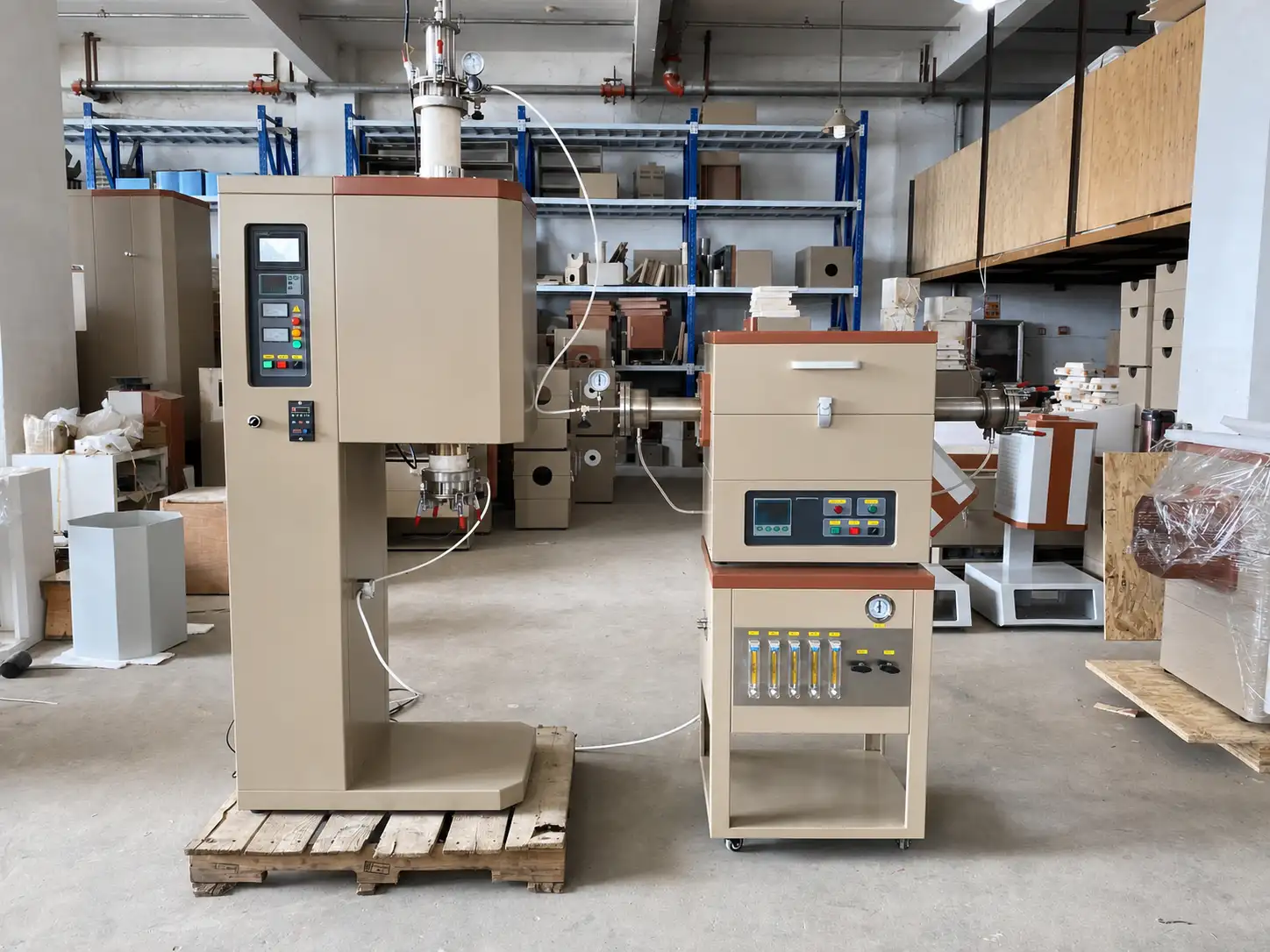
The project evidence shows a fixed vertical tube furnace, a horizontal tube furnace and a mobile five-channel gas-flow cabinet arranged as a coordinated equipment package. The two orientations create different loading, support and gas-path questions even when both use a process tube and controlled heating.
Use orientation as a process decision
The vertical furnace provides top-to-bottom access and connections, while the horizontal furnace supports a side-loaded process path. Selection should follow sample support, material movement, gas direction, condensation or collection behaviour and the available installation envelope. Orientation must not be chosen only from cabinet appearance.
Support the complete process tube
Flanges, gauges, valves and gas lines add weight and bending load beyond the heated enclosure. The layout must identify which supports carry the tube and which carry the end assemblies. Brittle process tubes should not be expected to support heavy fittings, and thermal expansion must be considered between hot and cold interfaces.
Map five gas channels before selecting components
The published image proves a five-channel flow-control arrangement, not the gases or universal flow ranges. A new project should identify each gas, source pressure, purity, required flow, isolation, check or purge function, mixing point and destination. The smallest fitting and the complete exhaust route can influence the usable system.
Separate gas control from the pressure boundary
Flowmeters regulate delivery, while seals, the process tube, valves, gauges, pump and exhaust establish the pressure boundary. State whether the process operates near atmosphere, under positive flow or with evacuation and backfill. The intended sequence determines valve logic, purge volume, pressure measurement and interlocks.
Coordinate two furnaces without assuming one cycle
The two furnace orientations may support separate process stages or different experiments. Define whether they operate independently, share gas services or require a coordinated sequence. Power capacity, ventilation, gas storage, exhaust and operator access must be checked for the complete installation rather than one cabinet at a time.
Information for a similar tube-furnace system
- Process objective for each furnace orientation
- Tube material, diameter, length and end interfaces
- Sample, holder, feed or collection arrangement
- Working cycles, heated lengths, zones and sensor positions
- Every process and purge gas with required flow and pressure
- Pump, vent, exhaust and gas-safety boundary
- Control relationship, data, alarms and interlocks
- Installation drawing, utilities, destination and documentation
Review Vertical Tube Furnaces, Vacuum & Atmosphere Tube Furnaces and How to Specify a Tube Furnace.